"Made in Vietnam" on natural pet toys: what US origin marking asks for
Under 19 CFR 134.11, every article of foreign origin imported into the United States, or its container, must show the English name of its country of origin in a conspicuous place, as legibly and permanently as the article allows. For natural pet toys from us that means "Vietnam", in English, where the end buyer will see it. Whether that goes on the toy itself or on the bag it is sold in is a question for your customs broker, and the answer shapes your label design.
- For US importers and Amazon sellers
- Labels and packaging
- About 6 minutes to read
What the rule says, in its own words
The rule is in Title 19 of the Code of Federal Regulations, part 134. Section 134.11 says every article of foreign origin "(or its container)" must be "marked in a conspicuous place as legibly, indelibly, and permanently as the nature of the article (or container) will permit", in a way that tells "an ultimate purchaser in the United States the English name of the country of origin". You can read it on Cornell Law School's Legal Information Institute or on the official eCFR.
Section 134.41 adds the practical test: "The marking must survive normal distribution and store handling. The ultimate purchaser in the United States must be able to find the marking easily and read it without strain."
The "ultimate purchaser" is usually the person who buys the toy in a shop or on Amazon. A mark only on the shipping carton does not reach that person if the carton is opened in a warehouse and thrown away.
The toy itself, or the bag it is sold in?
The rule allows for articles that are hard to mark. Section 134.32 lists exceptions, including articles "incapable of being marked", articles that cannot be marked "without injury", and articles "for which the marking of the containers will reasonably indicate the origin". When an article is excepted, section 134.22 says the outermost container in which it ordinarily reaches the end buyer must still be marked.
Natural chews are a good example of why this matters. A coffee wood stick, a loofah bone or a coir ball has an uneven natural surface, and every piece has its own shape. A printed sticker on wood can peel. Whether your product counts as one that can be marked, and whether marking the retail bag is enough, is decided by US Customs, and your broker can tell you how they see it. We do not decide it for you.
Section 134.41 also suggests marking "worked into the article at the time of manufacture". On coffee wood we offer laser engraving of a logo, for a fee, after the order is confirmed. If your broker wants the origin on the wood itself, raise it with us before we quote.
When your US company name is on the pack
Private-label sellers should read two more sections. Under section 134.22(c), a container that carries the name and address of a US importer or seller must show the origin of the contents close to that address, with wording such as "Contents made in France". Under section 134.46, if the name of a US city, "USA" or similar words appear on the article or its container and could mislead the buyer about where it was made, the country of origin must appear close by, in at least a comparable size, after words such as "Made in" or "Product of".
In practice: if your bag or tag says "Austin, Texas" under your brand name, put "Made in Vietnam" right next to it, not in small type on the back. Ask your broker to look at the artwork before you print.
Where we put "Made in Vietnam" today
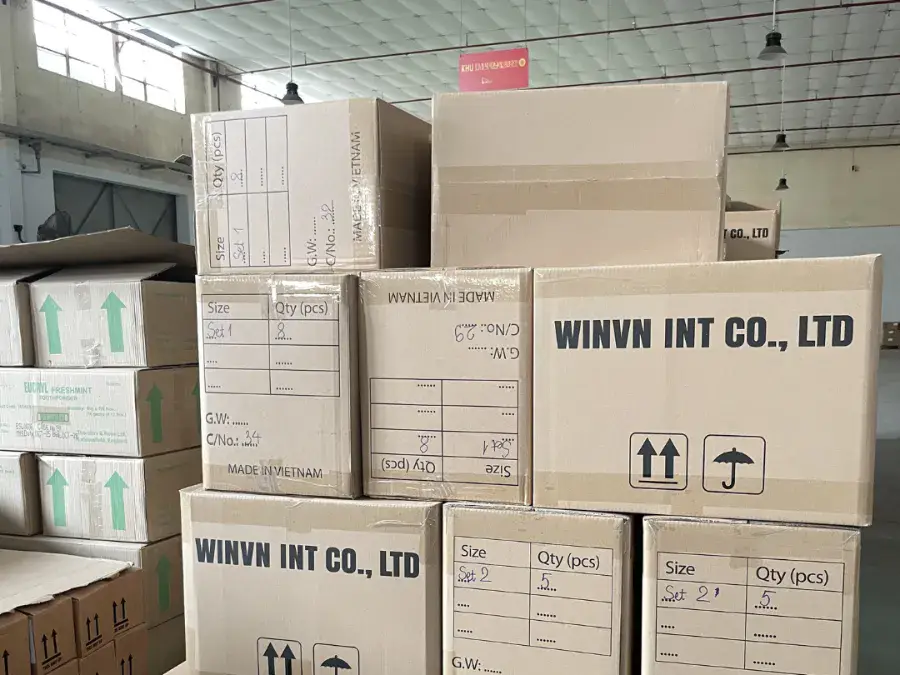
For Amazon FBA cartons, a Made in Vietnam label sits beside the FBA label, and the shipping mark follows Amazon's format. For other orders, our shipping mark starts with our company name and Ho Chi Minh City, Vietnam, or follows your own format. The photo at the top shows our cartons with the origin printed on them.
Inside the carton, the retail pack is designed around your label:
- Your tag goes inside the bag, sealed in before the bag is closed. Our standard tag is 5 × 9 cm, and we print other sizes to your file.
- The barcode goes on the outside, with the suffocation warning on every bag beside it.
- The country of origin is part of your artwork. We print what your approved file says, so the place to get "Made in Vietnam" right is the design stage. Designing the label for you is a paid service, quoted with your order.
- We label one carton first, you approve it, and only then do we label the rest.
Bag-by-bag details for each material are in packing natural pet toys for FBA, by material, and carton labels in FBA carton labels and box content.
A checklist for your label file
- The word "Vietnam" in English, readable without strain.
- On the bag or tag the end buyer will hold, if your broker says the toy itself is not marked.
- Next to any US address or US place name on the pack, in comparable size.
- Printed or fixed so it survives shipping and shelf handling.
- Matching the true origin. We only declare where the goods were really made, and our two factories are in Dak Lak and Gia Lai provinces in Vietnam.
If you are moving a product from another country, see sourcing natural pet toys from Vietnam instead of China, which starts with the question of true origin.
Questions buyers ask about origin marking
Does every pet toy need "Made in Vietnam" on it?
19 CFR 134.11 requires the article or its container to show the English name of the country of origin to the end buyer. Some articles are excepted and only their retail container is marked; your customs broker confirms which applies to your product.
Is "Made in Vietnam" on the shipping carton enough?
Usually the mark has to reach the end buyer, and a shipping carton is often opened and discarded before that. Mark the retail bag or tag, and ask your broker to confirm.
Can you engrave the origin on coffee wood?
We offer laser engraving of a logo on coffee wood, for a fee, after the order is confirmed. If you need the origin on the wood, raise it with us before we quote.
Where does my tag go?
Inside the bag, sealed in before the bag is closed. The barcode and the suffocation warning go on the outside of the bag.
My brand address is in the US. What changes?
Under 19 CFR 134.22(c) and 134.46, the country of origin should appear close to a US address or US place name on the pack, in comparable size.
See the packing before you design the label
Start with samples: your first 3 are free, you pay the shipping.
Private-label options and minimums by material: coffee wood chews.