
Size variations and barcodes for natural dog chews on Amazon
Give every size its own barcode, and make sure the size on your listing, the size on the bag and the product code we pack to all point to the same stick. You create the barcodes; we print them and put them on the bags. The bigger risk is a size name that means one thing to you and another to the factory.
- For Amazon FBA sellers
- Coffee wood chews, XS to XXL
- About 6 minutes to read
Does each size need its own barcode?
Yes. On our side, every size is packed and labelled as its own product, with its own barcode. A small stick and a large stick are different goods to a warehouse scanner, even if your listing shows them as one product with a size choice.
How you group the sizes on the listing is set up by you in Seller Central. What we need from you is a simple list: for each size you sell, the barcode you want on that bag. The same applies to sets. A 2-stick set and a 3-stick set are separate products with separate codes, in our system as well as yours.
- You create the barcodes. Generate them in Seller Central, or send us your own UPC or EAN codes.
- We print and apply them on the outside of each bag.
- One code per size, per set. A size M single and a size M set of 2 do not share a barcode.
Why size names cause the real problems
Size names are not a standard. Each buyer calls sizes their own way, and one buyer's "Medium" can be one step off from ours. If that is not caught, a whole lot is packed in the wrong size, and the barcodes on the bags send the wrong stick to the wrong listing.
That is why we ask at the start which size system you use, and then pack to our product code, not to the word on the label. Your "Large" might be our CC01M or our CC01L. Once the code is fixed in writing, the name printed on your bag can be anything you like.
| Our code | Our size | Length × diameter (cm) | Weight per stick |
|---|---|---|---|
| CC01XS | XS | 10–11 × 1.5–2 | 23–30 g |
| CC01S | S | 13–14 × 2–2.5 | 35–45 g |
| CC01M | M | 17–18 × 2.5–3.5 | 90–110 g |
| CC01L | L | 18–19 × 3.5–4.5 | 120–180 g |
| CC01XL | XL | 20–21 × 4.5–5.5 | 230–400 g |
| CC01XXL | XXL | 22–23 × 5.5–8 | 325–600 g |
Sets use their own codes: S2CC01 for 2 sticks, S3CC01 for 3 sticks. More on each size in coffee wood chew sizes, XS to XXL.
A simple mapping sheet before production
We suggest one short table that both sides sign off before production, with one row per thing you sell:
- Your size name, as it appears on your listing and bag
- Our product code (for example CC01L or S2CC01)
- Your barcode for that row
- Quantity
With that sheet, the person packing reads the code, the person labelling reads the barcode, and nobody has to guess what "Large" means. It also makes it easy to split an order. Our minimum is 50 pieces per item, and you can split that across sizes however you like, with one row per size.
Where the barcode sits on the bag
Each bag carries several things, and each has its place:
- Barcode: on the outside of the bag.
- Suffocation warning: on every bag, beside the barcode on the same face. The wording we use is in suffocation warnings on pet toy bags.
- Size label: on the outside of the bag.
- Your tag: inside the bag, placed before the bag is sealed.
In the export carton, each size goes in its own large inner bag, so sizes are never mixed together loose. If the last cartons have to mix sizes, those mixed cartons are packed to the same weight as each other. The wider packing rules are in packing natural pet toys for FBA, by material.
What a size range promises
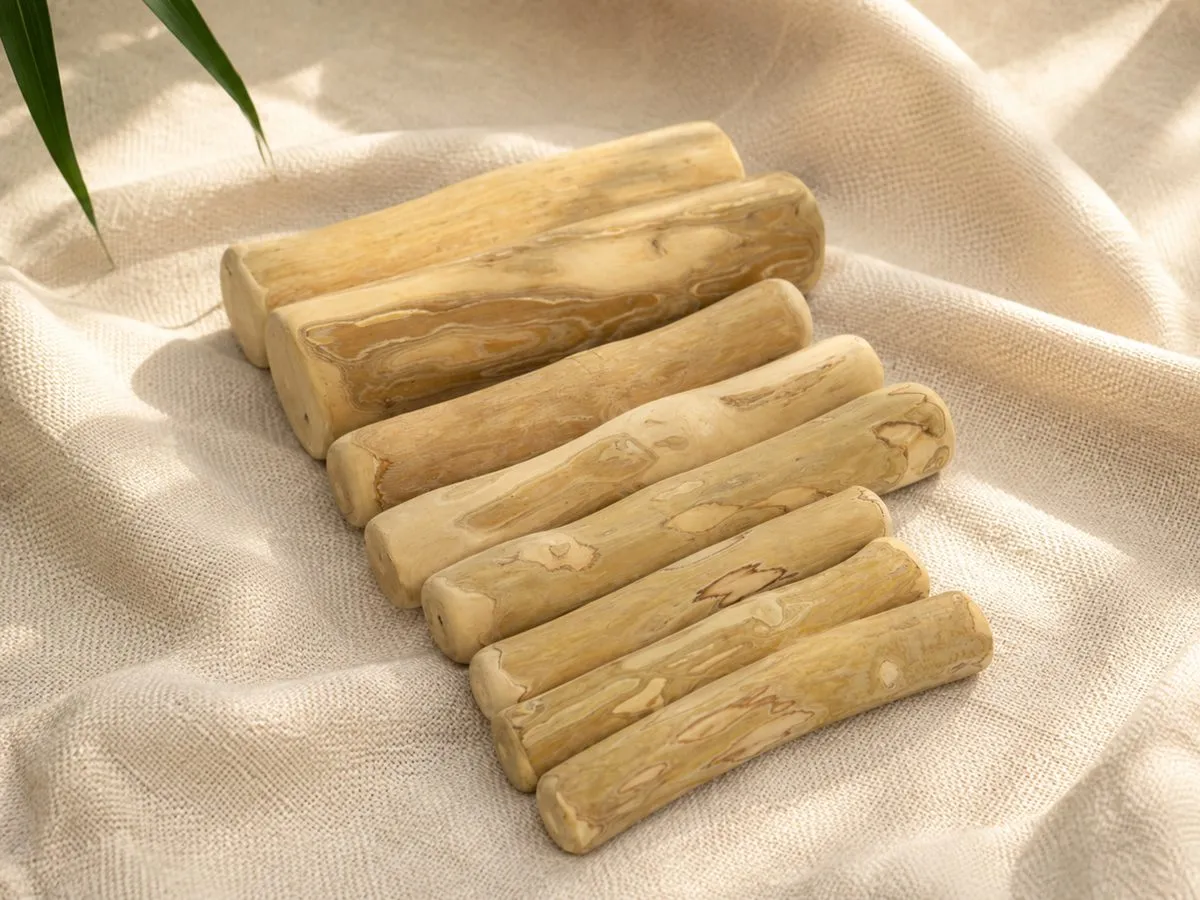
Coffee wood is a natural material. Every stick has its own shape and grain, and sizes are ranges, not exact numbers. Length can vary by about 0.5–1 cm. Diameter varies more on the bigger sizes: 0.3–0.5 cm on XS and S, 0.5–1 cm on M and L, and 1.5–2.5 cm on XL and XXL.
On your listing, give the size as a range and say plainly that each stick is unique. A buyer told about the range in advance is less likely to be surprised by it. Wording that holds up in reviews is covered in writing a natural dog chew listing without overpromising.
It also helps to repeat the plain safety advice on the listing: supervise the dog while it chews, replace the chew once it has worn small, and remove any broken pieces.
Checks we run before the cartons close
- Count labels on arrival. When your tags and barcodes reach us, we count them against the order straight away. A shortage found on packing day delays the whole shipment.
- Read the code, not the name. Packers work from the product code on the sheet.
- Label one carton first. One carton is packed and labelled, checked and approved, and only then is the rest done.
A size mix-up is cheap to stop at the sheet and expensive to fix after it reaches a fulfilment centre.
Questions sellers ask about sizes and barcodes
Do you create the barcodes for my listing?
No. You create them in Seller Central or send us your UPC or EAN codes, and we print them and apply them to each bag.
Does each size need a different barcode?
Yes. Each size is packed as its own product with its own barcode, and sets of 2 or 3 have their own codes too.
My size names are different from yours. Is that a problem?
No, as long as we agree in writing which of our product codes each of your size names means. We pack to the code, so your bag can say whatever you choose.
Can I split the minimum order across sizes?
Yes. The minimum is 50 pieces per item, and you can split it across sizes as you like.
Are the sizes exact?
No. Each stick is natural wood, so length and diameter are given as ranges, with a tolerance in centimetres that is wider on the larger sizes.
See the sizes in your hand first
Start with samples: your first 3 are free, you pay the shipping.