A customer says their dog swallowed rope toy fibres. What should a seller say?
Tell the customer to contact their vet, today, and do not guess whether the dog will be fine. A seller is not in a position to judge a dog's health, and veterinary sources treat swallowed string-like material as a higher-risk case. After that, help with the product side: what the toy was, its condition, and how to prevent a repeat.
- For pet shops and Amazon sellers
- Hemp, coir and other rope toys
- About 5 minutes to read
Why the answer is always "call your vet"
Rope toys are made of string-like fibre. Cornell University's Riney Canine Health Center notes that "foreign bodies like string or ribbon (linear foreign bodies) can cause more severe damage", and that "prompt veterinary intervention is critical to achieving the best outcome for your dog."
No seller can tell from a message how much a dog swallowed or how it will pass. Some product pages online say a few natural fibres are harmless; we have found no veterinary source that says so, and we would not repeat it to a worried owner. Sending them to a vet is the correct answer and also the kind one.
A reply you can adapt
Keep it short, calm and clear. Put the vet first, the product questions second.
Thank you for telling us, and I'm sorry this happened. Please contact your vet today and tell them your dog may have swallowed rope fibres; they are the right people to advise you. If you see fibre or string hanging from your dog's mouth, please do not pull it, and tell your vet. When your dog has been seen, we'd like to help with the toy itself. Could you send a photo of it, and tell us roughly how long it had been in use?
The "do not pull" line is there for a reason. The Merck Veterinary Manual says a string-like object found in the mouth "must never be pulled". Repeat that, and leave every other medical step to the vet.
What not to say
- "It's natural, so it will pass." Natural fibre is still fibre. You do not know that, and neither do we.
- "Watch and wait." That is a veterinary judgement, not a seller's.
- Any home remedy. No advice on feeding, inducing vomiting or anything else. Only the vet.
- Blame. Even if the toy was worn out, the first message is not the moment.
If the customer lists symptoms, you can mention that Cornell lists vomiting, loss of appetite, abdominal pain, diarrhoea, dehydration and lethargy among the signs of a swallowed object. Use that only to underline "see your vet now", never to reassure that a dog without symptoms is fine.
The product side: what to ask, what to record
Once the dog is being looked after, the questions are about the toy:
- Which product and size was it, and from which order?
- How long had it been in use, and was it frayed before?
- Was the dog playing alone or with someone?
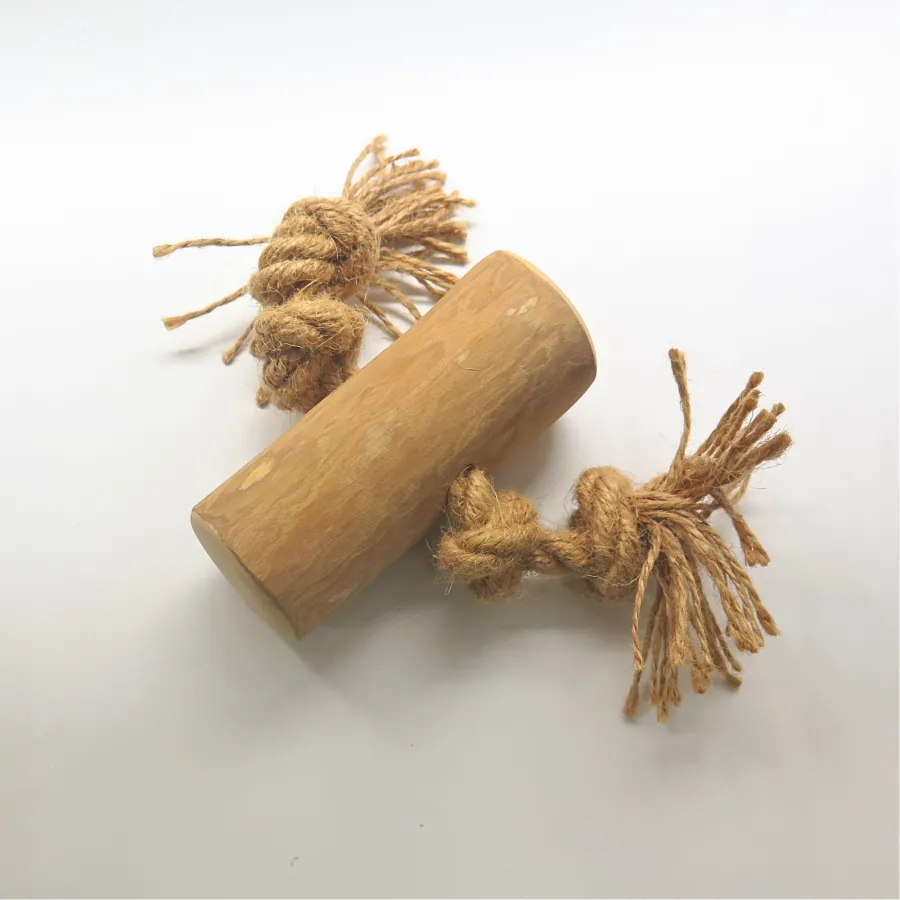
- Is it a hemp toy, a coir toy, or a mixed toy such as rope on wood?
Keep a short log. A pattern tells you more than any single message: a material sold to the wrong kind of chewer, a size too small, a listing that promises too much. If you buy from us and think a batch is not like the sample you approved, send photos; a video of opening the next carton helps us check it properly.
Fewer of these messages: set expectations in the listing
Most of the prevention happens before the sale. Two lessons from our own range:
Coco coir is soft
Coir frays quickly under a strong jaw. Sold as a long-lasting toy for heavy chewers, it collects one-star reviews, and a few of those can sink a listing. Sold as an occasional toy, it does fine. Say plainly before the sale that it is not for strong chewers. More in how long coco coir toys last.
Hemp lasts longer than coir, but it still frays
Hemp fibre is hard and strong, and more durable than coir. It still frays in the end. Hemp balls are handmade, so agree the size range against an approved sample; the full checklist is in hemp rope dog toys: what to check. Whether swallowed hemp is any safer than cotton is not proven; see hemp vs cotton rope dog toys.
Put the safety lines where owners will read them
A tag inside the bag (our standard is 5 × 9 cm) is a good place for four lines: supervise play; check the toy often; remove it once it frays; throw away loose strands. Cornell gives the same core advice: "Supervise your dog during playtime to prevent ingestion of inappropriate items." Listing wording that stays on the right side: writing a natural dog chew listing without overpromising.
Questions sellers ask about swallowed rope fibres
What should I tell a customer whose dog swallowed rope fibres?
Tell them to contact their vet today and not to pull any fibre hanging from the dog's mouth. Leave every medical judgement to the vet, then ask about the toy.
Are natural fibres safe if swallowed?
We have found no veterinary source that says so. Veterinary sources describe swallowed string-like material as higher risk, whatever the fibre.
Is hemp safer than cotton if swallowed?
No study we found shows that. Treat any rope fibre as string-like material and supervise play.
How can I reduce these complaints?
Match the material to the chewer, sell coco coir as an occasional toy, and print supervise-and-replace lines on the tag or listing.
Are your hemp and coir toys lab-tested?
Not yet. Our only lab report covers coffee wood. If you need a test, tell us before ordering; new tests are paid by the buyer who needs them.
Check the fibre before you list it
Start with samples: your first 3 are free, you pay the shipping.