How to explain natural variation in dog chews to your customers
Tell customers the truth in one sentence: each chew is cut from a real tree, gourd or fibre, so no two are exactly alike in shape, grain or size. Then show them the size range in centimetres, explain the small surface changes wood makes after the bag is opened, and know which faults are real defects to pull from the shelf.
- For pet store owners and staff
- Coffee wood, loofah, hemp, coco coir
- About 6 minutes to read
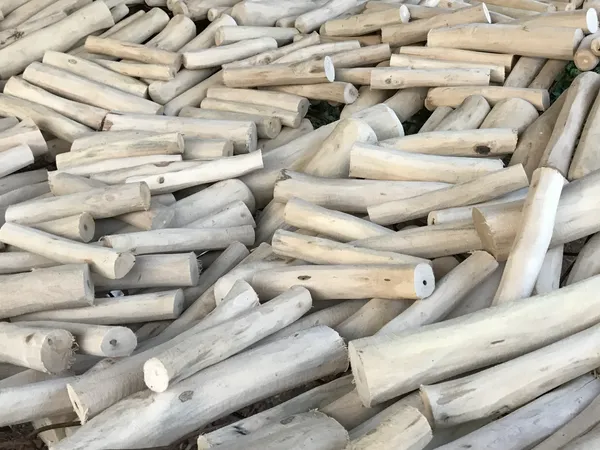
Why no two pieces are the same
A coffee wood chew starts as a section of a Robusta coffee tree more than 20 years old, cleared so the farm can be replanted. We remove the bark, keep the central part of the trunk, cut off the ends that are cracked or decayed, and reject sections that are bored by insects, hollow, bent or deeply cracked. What is left is still a natural piece of wood. Every stick has its own shape and its own grain.
The same is true of the other natural lines. Loofah toys are cut into shapes from dried gourds left to mature for 6–9 months. Coco coir toys are hand-knotted from machine-twisted coir rope. Hemp balls are handmade, so their size varies a little and is agreed against an approved sample.
For a customer used to moulded plastic or nylon, this is the first thing to say. Variation is how a natural product is recognised, and it is why the chew in their hand will not look exactly like the photo on the shelf card.
Size: give a range, not a single number
Natural chews are sold by size band, and each band is a range. Showing that range on the shelf stops the "this one is smaller" conversation before it starts.
| Coffee wood size | Length × diameter | Weight per stick |
|---|---|---|
| XS | 10–11 × 1.5–2 cm | 23–30 g |
| S | 13–14 × 2–2.5 cm | 35–45 g |
| M | 17–18 × 2.5–3.5 cm | 90–110 g |
| L | 18–19 × 3.5–4.5 cm | 120–180 g |
| XL | 20–21 × 4.5–5.5 cm | 230–400 g |
| XXL | 22–23 × 5.5–8 cm | 325–600 g |
On top of the range, length can vary by about 0.5–1 cm, and the diameter allowance widens with size, from 0.3–0.5 cm on XS and S up to 1.5–2.5 cm on XL and XXL. Wood also swells a little in heat and shrinks in cold, by up to 0.5 cm, and longer pieces move more. Gorilla coffee wood blocks vary even more: 8–16 cm and roughly 155 g to 1.1 kg across the range. Full details are in coffee wood chew sizes, XS to XXL.
Small cracks after opening: what is normal
Fine surface checks that appear after a bag is opened are normal for natural wood. Our coffee wood is vacuum-sealed to slow the exchange of moisture with the air. Once the bag is opened, the wood slowly balances with the room around it, and its surface can change a little as it does.
Heat speeds this up. Wood can start to crack from around 40 °C, depending on how much moisture it holds. Keep stock sealed until it goes on display and keep display stock out of direct sun.
How much cracking is acceptable in a delivery is agreed before the order: we write the accepted level on the proforma invoice before you pay a deposit. The background is in why coffee wood chews crack and why we measure moisture at the core.
What is a real fault
Natural variation is not an excuse for a bad piece. Pull these from the shelf and tell your supplier:
- a deep crack running through the whole piece;
- a hollow core;
- a size clearly different from what was ordered.
If you buy from us, film the cartons as you open them. When a real defect goes beyond the level agreed on the proforma, we replace the excess free of charge in your next shipment.
Words your staff can use
Short, honest lines work better at the counter than long explanations. These are the ones we would use:
- "Each one is cut from a real coffee tree, so the shape and grain are unique."
- "The size is a range. This M is 17 to 18 centimetres; pick the one that suits your dog."
- "Once the bag is open, the wood settles to the air in your home. A few fine lines on the surface are normal."
- "Watch your dog while it chews, replace the chew when it gets small, and throw away any loose pieces."
If a customer asks whether a chew suits a dog with a health problem, send them to their vet. More selling ideas for the shop floor are in selling natural dog chews in your store.
Questions customers ask about natural variation
Why does my coffee wood chew look different from the photo?
Each chew is cut from a real tree, so shape and grain differ from piece to piece. Size is sold as a range in centimetres.
Why did fine cracks appear after I opened the bag?
Vacuum sealing slows moisture exchange. After opening, natural wood balances with the room, and small surface changes are normal.
Is a crack a defect?
Fine surface lines are normal. A deep crack through the whole piece or a hollow core is a fault and should be returned to the store.
Why are two chews of the same size different weights?
Length, thickness and shape vary within each size band. An M stick, for example, weighs 90–110 g.
Do hemp and loofah toys vary too?
Yes. Hemp balls are handmade and loofah shapes are cut from dried gourds, so small differences in size are normal.
Show the range on your shelf
Start with samples: your first 3 are free, you pay the shipping.
Ask for samples Coffee wood chews
Mixing materials in one order: mixed orders.