Why coffee wood chews crack and splinter, and how to keep it to a minimum
Coffee wood cracks for three main reasons: it has been dried too far, it has been exposed to heat, or it has taken on and lost moisture in transit. Large sizes are the most sensitive. Cracking cannot be removed from a natural wood product, but it can be kept low by measuring moisture at the core, vacuum-sealing the wood and keeping it cool, and it can be agreed in writing before an order is paid.
- For importers and Amazon sellers
- Coffee wood only
- About 6 minutes to read
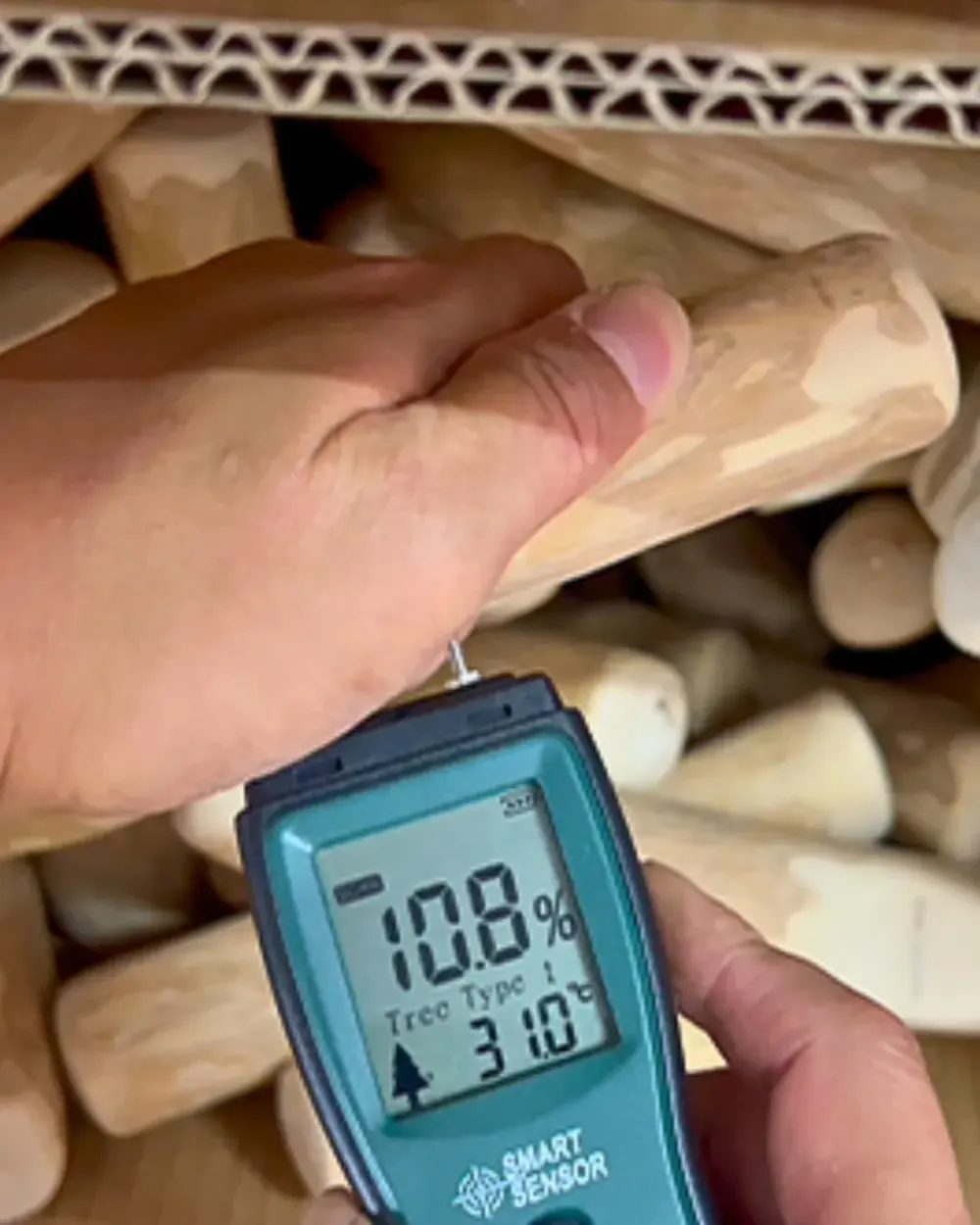
Why some sticks split in minutes and others last
Customers compare notes. One says the stick lasted well, another says it split almost at once. Both can be true of the same product, because each stick is natural wood with its own shape and grain. But when cracking is frequent across a batch, the cause is usually one of the three below, and each has a fix on the factory side or on the seller side.
Cause 1: the wood was dried too far
It sounds backwards, but drier is not better for natural coffee wood. The wood is dense and hard already. Pushing it down to 10–12% moisture makes the large sizes crack heavily. Small sizes such as S and M can reach that range; large sizes cannot without cracking.
That is why our limit is a single figure for every size: below 14%, measured at the core, before vacuum packing. The core matters because thick wood dries from the outside in. Our XL sticks are 4.5–5.5 cm across and XXL sticks 5.5–8 cm, against 1.5–2 cm for XS, so a surface reading on a big stick says little about its centre.
Specifications asking for 6–8% usually come from furniture or engineered timber, which reaches those numbers with chemicals and pressure drying. Our chews are natural wood: no chemicals are added in production, and there is no pressure-stabilising step. The full reasoning is in why we measure moisture at the core.
Cause 2: heat
Cracking can start from around 40 °C, depending on how much moisture the wood still holds. Heat can reach the wood at several points between our warehouse and a dog's mouth:
- A container standing in the sun at a port.
- A warehouse without air flow in summer.
- A shop window, a car boot, or a shelf above a radiator.
On our side, we move wood in the cooler hours of the day and avoid strong midday sun. On yours, keep cartons out of direct heat, and tell customers to keep the chew in its bag, away from heat, until use. Storage is covered in more detail in storing coffee wood chews.
Cause 3: moisture changes in transit
A moisture reading describes the wood on the day it was taken. Without a barrier, the same wood absorbs moisture again on a sea voyage in the rainy season, and the figure we measured no longer describes it. A sealed bag limits both the moisture change and the cracking that comes with it.
- Our coffee wood is vacuum-sealed, 1, 2 or 3 pieces per bag, with a desiccant pack inside.
- Without vacuum packing, cracking increases by 15–20%.
- Kraft bags and cartons alone are not a moisture barrier. Wood packed only that way cracks about as much as unpacked wood. We do not yet have an eco-friendly alternative to the vacuum bag.
- After the bag is opened, the wood slowly balances with the room. That is normal for natural wood.
If you repack into retail boxes, keep the vacuum bag inside the box. Packing by material for Amazon is in packing natural pet toys for FBA.
What we remove before a stick is cut
Some cracking starts in the tree, long before drying. We take the bark off and keep the core of the log, and cut away both ends, about 5–7 cm each, where old wood is often cracked or decayed. Pieces with insect damage, hollow centres, bends or deep cracks are rejected. After that, cracks are checked again through five QC steps: raw material, in-process, semi-finished, final product and pre-shipment. Wood is also checked for cracks as soon as it arrives at our warehouse, and cracked pieces are set aside.
Agree the crack level before you pay
Natural wood will always show some fine cracks. The accepted crack level is written on the proforma invoice before you pay a deposit. Size tolerances in centimetres are a separate line on the same proforma.
If a shipment arrives with real defects beyond that level, such as deep cracks running through a whole stick, hollow centres, or sizes outside the purchase order, the process is simple. Film a video while opening the cartons. Defects beyond the agreed level are replaced free of charge in your next shipment. Our responsibility runs to the moment the wood is vacuum-sealed; bags opened and left in hot, humid conditions on the buyer's side are outside it.
Handling an "it splintered" review
A calm, factual reply does more for the next buyer than an apology alone. Thank the customer, explain that natural wood can crack, especially when very dry or warm, and repeat the care advice: supervise the dog, remove any fragments, and take the chew away once it is worn small. Avoid promising that a stick will never splinter. That promise is what turns the next crack into another one-star review.
More on review patterns for natural chews in handling one-star reviews on natural chews.
Questions about coffee wood cracking
Why do coffee wood chews crack?
Mostly because the wood was dried too far, exposed to heat from around 40 °C, or took on and lost moisture without a vacuum seal.
Would drier wood crack less?
No. Drying coffee wood to 10–12% makes large sizes crack heavily, which is why our limit is below 14% at the core for every size.
Does vacuum packing help?
Yes. Without vacuum packing cracking increases by 15–20%, and kraft bags or cartons alone are not a moisture barrier.
How much cracking is acceptable?
The accepted crack level is written on the proforma invoice before you pay a deposit.
What if a shipment arrives badly cracked?
Film the cartons being opened. Defects beyond the agreed level are replaced free of charge in your next shipment.
Check the wood before you commit
Start with samples: your first 3 are free, you pay the shipping.