One-star reviews on natural dog chews: the usual causes and how to prevent them
This guide covers four kinds of one-star review on natural chews: the chew cracked or splintered, it was gone too fast, it was the wrong size, or a coir toy frayed. Many of them start before the order ships, in the size you chose, the way the goods were packed and what the listing promised.
- For Amazon and marketplace sellers
- Coffee wood, hemp, coco coir
- About 7 minutes to read
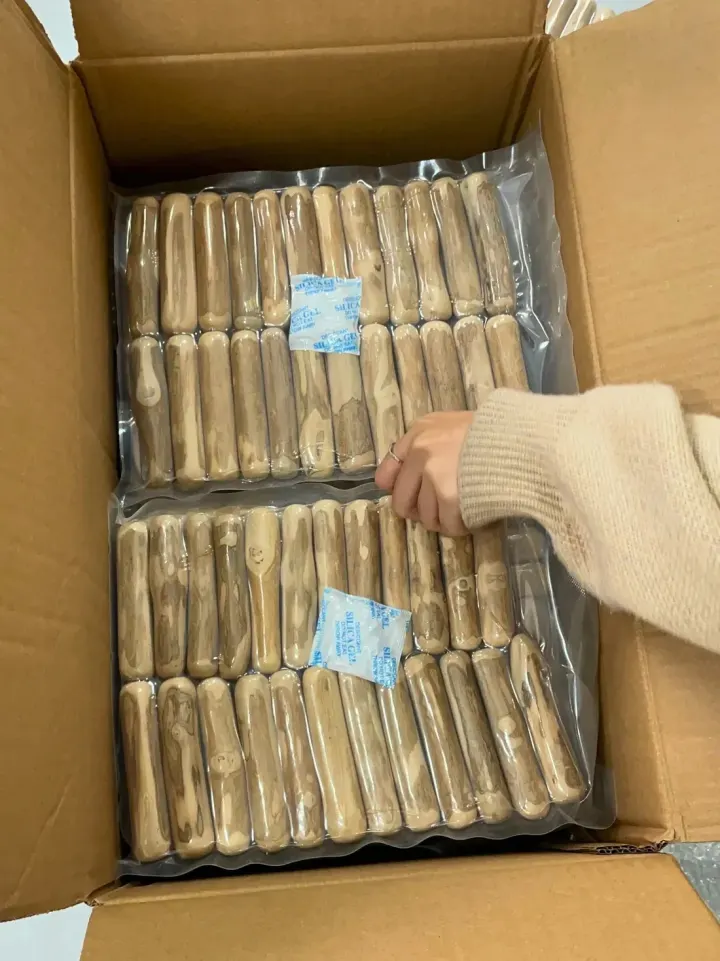
"It cracked" or "it splintered"
On wood chews, the cause is usually moisture and heat. Wood that dries further after packing, or heats up in storage, opens along the grain.
What causes it
- Heat. Coffee wood can start to crack from around 40 °C, depending on how much moisture it still holds.
- No moisture barrier. Wood that is checked but not vacuum-sealed takes moisture back on a rainy-season voyage, then dries again in your warehouse.
- Opening the bag. Once the vacuum bag is open, natural wood slowly balances with the room. Small surface changes after that are normal behaviour for wood.
How to prevent it
- Buy wood measured at the core and sealed. Ours is below 14% at the core before vacuum packing, with a desiccant in each bag. See why we measure moisture at the core.
- Keep stock in the sealed bag until it ships to the customer, and away from heat.
- Agree the accepted crack level in writing. Ours is written on the proforma invoice before you pay a deposit.
- Tell buyers in the listing that wood adjusts after opening, and that the dog should be supervised, the chew replaced when small and loose pieces removed.
The longer explanation is in why coffee wood chews crack.
"Gone in five minutes"
A chew that disappears fast was usually the wrong size or the wrong material for that dog. Shorter, thinner sticks wear down faster than thick ones; that is also why owners come back to buy again. The problem is only when the listing suggested otherwise.
- Show sizes in centimetres, not just S, M, L, so owners can compare with the dog in front of them. Our sizes run from XS (10–11 cm long, 1.5–2 cm across) to XXL (22–23 cm, 5.5–8 cm across).
- Do not promise a number of days or weeks. Say the chew wears down gradually.
- Sell coco coir for what it is: a soft, occasional toy whose fibres brush between the teeth. It frays quickly under a strong jaw. Offer hemp, which is more durable than coir, to owners of hard chewers.
- Think twice before listing coir rope pushed into a wood chew on a marketplace. It sells in shops, where staff can explain it, but on a marketplace it easily draws one-star reviews.
More on wear and replacement: how long a coffee wood chew lasts.
"Smaller than pictured" or "wrong size"
Size complaints come from two places: size names that mean different things to different people, and the natural spread of a wood product.
Size names are the bigger trap. Different buyers call the same stick by different names, and we have seen a buyer's sizes sit one step away from ours. If nobody notices, a whole order is packed one size off. We prevent it by asking which size system you use at the start and packing by product code, such as CC01M, not by the word "Medium". Put the code and the centimetres on your own label too.
The second cause is tolerance. Length varies by about 0.5–1 cm, and diameter by a range that grows with the size. Wood also swells in heat and shrinks in cold, by up to 0.5 cm. Write ranges in the listing ("17–18 cm") instead of a single number, and the product will match what the buyer reads.
"Arrived damaged" or "spots in the bag"
Check every delivery when it lands, before it goes into the fulfilment centre or onto shelves. Our quality responsibility runs up to the moment the goods are vacuum-sealed, so a seller who records the condition on arrival is in a much stronger position.
- Film the unpacking. If you find a real defect beyond the agreed level (deep cracks through the whole piece, a hollow core, sizes different from the PO), send us the video. We replace the excess free of charge in your next shipment.
- Dust is the main cause of mould spots, rather than the wood itself, which is why we clean surface dust carefully before packing. Bags opened in hot, humid conditions are outside what we can control.
- Send your tags and barcodes early. We count them as soon as they reach our warehouse, because a shortfall found close to the ship date means missing labels.
How to answer a one-star review
Reply in public, briefly, and without arguing. A good reply does four things: it admits what went wrong, says what has been changed, states the standard clearly, and gives the customer a clear choice such as a replacement or a refund. Future buyers read the reply as well as the review.
Two things you must not do. Under the US Federal Trade Commission's rule on consumer reviews, using unfounded legal threats or intimidation to get a review removed, or hiding negative reviews while presenting the rest as the full picture, is treated as an unfair or deceptive practice (16 CFR 465.7, FTC). The same rule covers offering "compensation or other incentives in exchange for, or conditioned expressly or by implication on" a review's sentiment (16 CFR 465.4, FTC). Fix the product and the listing; leave the review where it is.
Wording that avoids these reviews in the first place: writing a natural chew listing without overpromising.
Questions sellers ask about bad reviews
Why do some coffee wood chews crack quickly and others last?
Moisture and heat are the usual causes. Wood measured at the core, vacuum-sealed and kept away from heat cracks less than wood that dries out or heats up after packing.
What crack level is acceptable in an order?
It is agreed per order. We write the accepted level on the proforma invoice before you pay a deposit.
What do you do if goods arrive with real defects?
Send a video of the unpacking. Defects beyond the agreed level are replaced free of charge in your next shipment.
Can I ask a customer to remove a one-star review?
You can reply and offer to fix the problem. In the US, threats, intimidation or incentives tied to a review's sentiment fall under the FTC's consumer review rule.
Is coco coir a bad product for Amazon?
Coir works when it is sold as a soft, occasional toy. It draws bad reviews when it is sold as a tough chew.
Test before your first big order
Start with samples: your first 3 are free, you pay the shipping.
Ask for samples Coco coir toys
Packing by material for FBA: packing natural pet toys for FBA.