What to check in natural chew samples before you order
When natural chew samples arrive, check five things: the size in centimetres against the product code, the packing exactly as it will ship, the natural variation you will accept, how the material behaves with real dogs, and whether you would approve this piece as the standard for your whole order. That last point matters most. The sample you approve becomes the reference your bulk order is checked against.
- For importers, shops and Amazon sellers
- Coffee wood, hemp, coir, loofah
- About 6 minutes to read
Before the box arrives: choose samples that answer questions
Your first 3 samples are free, any items you choose, and you pay the shipping. A fourth sample and beyond is charged, and fully custom samples or samples with your label carry a fee. With only three free pieces, pick the ones that answer your real doubts: the size you expect to sell most, the largest size you plan to list, and the material you are least sure about.
For private-label or FBA samples with your own label, allow 10–15 days from the day the design is confirmed.
Ask by product code, not only by size name. Size names differ between suppliers and between buyers, and a buyer's size names can be one step off ours. We pack by code, so naming the code avoids a wrong sample and, later, a wrong order.
Coffee wood: size, shape and cracks
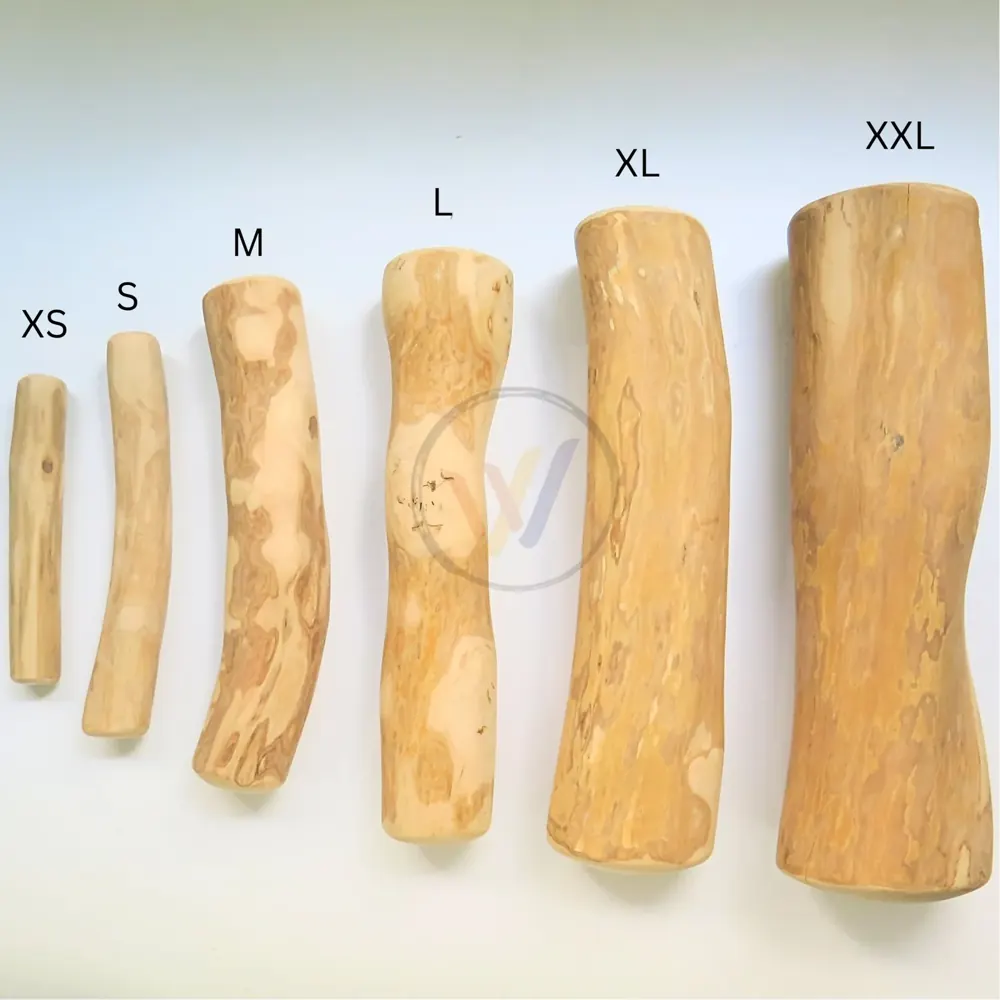
Measure length and diameter with a ruler and compare them with the size table. Every stick has its own shape and grain, so you are checking that it falls within range, not that it matches a photo.
| Size | Length × diameter | Weight per stick |
|---|---|---|
| XS | 10–11 × 1.5–2 cm | 23–30 g |
| S | 13–14 × 2–2.5 cm | 35–45 g |
| M | 17–18 × 2.5–3.5 cm | 90–110 g |
| L | 18–19 × 3.5–4.5 cm | 120–180 g |
| XL | 20–21 × 4.5–5.5 cm | 230–400 g |
| XXL | 22–23 × 5.5–8 cm | 325–600 g |
Tolerance is in centimetres: about 0.5–1 cm on length, and on diameter 0.3–0.5 cm for XS and S, 0.5–1 cm for M and L, 1.5–2.5 cm for XL and XXL. Wood also swells in heat and shrinks in cold, so a difference of up to 0.5 cm is normal. More in coffee wood chew sizes, XS to XXL.
Then look at cracks. Natural wood shows some, and the accepted level is written on the proforma invoice before you pay a deposit. Use the sample to decide what you can live with, and say so before the proforma is drafted.
Coffee wood: the bag tells you as much as the stick
Check the pack before you open it. It should be vacuum-sealed with a desiccant pack inside, your tag (if any) sealed inside the bag, and the suffocation warning on the outside. A bag that has lost its vacuum in transit is worth a photo and a message to us.
We measure moisture below 14% at the core before vacuum packing. Once you open the bag, the wood slowly balances with the air in your room. That is normal behaviour for natural wood, not a defect, so judge cracks on a freshly opened piece. Keep samples away from heat: cracking can start from around 40 °C. The reasons are in why we measure moisture at the core.
Hemp, coco coir and loofah: what varies
- Hemp balls are handmade, so size varies a little from ball to ball. The approved sample sets the standard. They are packed in a poly bag, not vacuum-sealed.
- Coco coir is machine-twisted rope, hand-knotted into balls and bones, with no glue. It is an occasional toy whose fibres brush between the teeth, and it frays quickly under a strong chewer. Test it with that in mind, and list it that way. See coco coir dog toys.
- Loofah shapes are cut from dried loofah, 11.5–15 cm long: teddy bear, fish, cat, kitty, bone and duck. They are vacuum-packed. We do not yet have data on how long loofah lasts with cats or dogs, which is exactly what a sample is for.
Let real dogs try them, carefully
If you test samples with dogs, test them the way your customers will use them, and write down what you see: which dog, which size, how long, what the piece looked like afterwards.
- Supervise the dog while it chews.
- Replace a chew once it has worn down small.
- Remove broken pieces or loose fibres straight away.
Those notes become the care advice in your listing. More on what to tell customers is in is coffee wood safe for dogs.
Approve in writing, then keep the sample
Our quality checks compare the bulk goods with the sample you approved, whether you approved it in hand or from photos and video. So approve clearly, in writing, and keep your sample somewhere safe. For your packing, we pack one sample unit first, you confirm it, and only then do we pack the order.
Film the unboxing of your bulk order too. If a real defect goes beyond what was agreed, a video makes the claim simple. How the checks run during production: five-step QC for natural chews.
Questions buyers ask about samples
How many free samples can I get?
Your first 3 samples are free, any items you choose, and you pay the shipping. From the fourth sample on they are charged.
Are custom or labelled samples free?
No. Fully custom samples and samples with your label carry a fee. Private-label samples take 10–15 days from the day the design is confirmed.
My coffee wood sample is a little longer than the table. Is that a problem?
Tolerance is about 0.5–1 cm on length, and wood swells in heat and shrinks in cold, so small differences are normal.
Why did the wood change after I opened the bag?
Vacuum sealing slows moisture exchange. Once opened, natural wood slowly balances with the air in the room, which is normal and not a defect.
What happens to my approved sample?
It becomes the reference. Our quality checks compare the bulk goods with the sample you approved, in hand or from photos and video.
Order your three
Start with samples: your first 3 are free, you pay the shipping.
Ask for samples Coffee wood chews
Questions about a mixed sample box? Tell us the codes you want and your market.