Is coffee wood safe for dogs? What we can tell you, and what to tell your customers
No dog chew is free of risk, and coffee wood is no exception. What we can tell you is exactly what the chew is: natural coffee wood from mature Robusta trees, with no chemicals added in production, measured below 14% moisture at the core before it is vacuum-sealed. Whether it suits a particular dog depends on the dog, the size chosen and supervision while it chews, and that is the honest answer we suggest you give your customers.
- For Amazon sellers and pet shops
- Coffee wood chews
- About 6 minutes to read
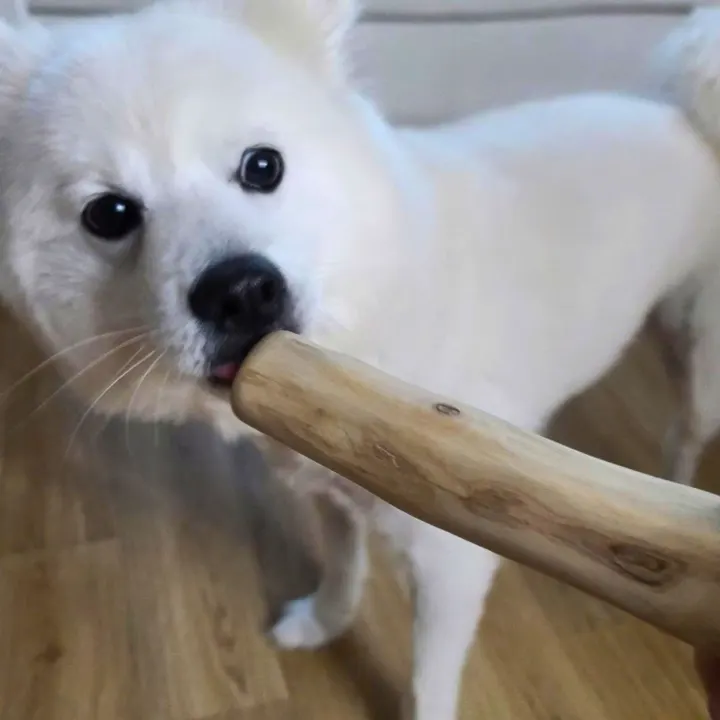
Why there is no one-word answer
Customers ask "is it safe?" and expect a yes. A seller who answers yes is making a promise about every dog that will ever chew the product, including dogs the seller has never seen. Dogs differ in jaw strength, in how fast they chew and in whether they try to swallow large pieces. A chew that suits one dog can be the wrong size or the wrong material for another.
So we do not call our chews "safe" in our own material, and we advise our buyers not to either. We describe what the chew is made of, how it is made and how it should be used. That gives your customer what they need to decide, and it gives you a listing that holds up when a review questions it.
What a coffee wood chew is made of
Our coffee wood is sourced from mature Robusta trees (20+ years) at the end of their productive life, cleared to make way for new planting. These are whole old trees removed during farm renewal in the Central Highlands of Vietnam, not pruned branches.
- Bark off, core kept. We take the centre of the log and cut away both ends, about 5–7 cm each, where the wood is often cracked or decayed.
- Pieces with insect damage, hollow centres, bends or deep cracks are rejected before cutting to size.
- No chemicals are added in production, and there is no pressure-stabilising step. It is cut and dried natural wood.
- Moisture below 14%, measured at the core before vacuum packing. Why that figure and not a lower one is explained in our guide to coffee wood moisture.
- Every stick has its own shape and grain. Two sticks of the same size will not look identical.
On our export documents a coffee wood chew is described as a wooden pet toy, because it is a toy, not food. That matters for how you describe it too: it is something the dog gnaws, not something it should eat.
Does coffee wood contain caffeine?
Many customers worry about this because of the name. We have no laboratory measurement of caffeine in coffee wood, so we do not publish a number or claim the wood is free of it. One common confusion is easy to clear up, though. The "Coffee Tree" listed as toxic to dogs on the ASPCA toxic plant list is Polyscias guilfoylei, family Araliaceae, a different plant from the Robusta coffee our chews come from. The full explanation is in coffee wood, caffeine and the ASPCA coffee tree.
What can go wrong with any wood chew
Wood is hard and it can crack. The questions a customer really cares about are when it cracks, how badly, and what to do about it.
Dry wood and heat both cause cracks
Very dry wood cracks more, which is why we do not push large sizes down to 10–12% moisture. Heat matters as well: from around 40 °C wood can start to crack, depending on how much moisture it still holds. A stick left in a hot car or a sunny window is more likely to split than one kept in its bag in a cool room. The causes and fixes are covered in why coffee wood chews crack and splinter.
The wrong size for the dog
Our sticks run from XS, 10–11 cm long and 1.5–2 cm across, to XXL, 22–23 cm long and 5.5–8 cm across. We do not publish a chart that matches sizes to dog weights, because dogs of the same weight chew very differently. Your customers should choose with their own dog in mind and ask their vet if they are unsure. Full dimensions are on the coffee wood product page linked below.
A stick that has worn down
Every chew gets smaller with use. A piece that was the right size when new can become small enough to swallow. That is the point at which it should be taken away.
What to tell your customers
This is the wording we suggest sellers adapt for a listing, an insert or a shop shelf card. It is general care advice, not veterinary advice.
- Supervise your dog while it chews, especially the first few times.
- Choose a size suited to your dog's mouth and chewing style. If unsure, ask your vet.
- Take the chew away once it is worn small enough to swallow, and replace it.
- Remove any loose fragments or sharp pieces that break off.
- This is a chew toy, not food. Do not let your dog eat it.
- Keep the chew in its sealed bag until use, away from heat.
- Natural wood varies in shape, colour and grain, and slowly adjusts to room air after opening. That is normal.
Keep absolute promises out of the listing: no claims that the chew cannot splinter, and no endorsements you cannot prove. More on this in writing a natural chew listing without overpromising.
What we check before the wood is packed
Our part of the answer is consistency: the stick your customer receives should match the sample you approved.
- Five QC steps: raw material, in-process, semi-finished, final product and pre-shipment. The reference at every step is the sample agreed with the buyer.
- Surface dust is cleaned off carefully. In our experience dust on the surface, more than the wood itself, is the main cause of mould.
- Vacuum-sealed with a desiccant pack in each bag, so the wood stays close to the moisture we measured.
- A suffocation warning goes on every bag, because the plastic bag itself is a hazard for children.
If your market asks about heavy metals, see what our SGS coffee wood test covers, and what it doesn't.
Questions customers ask about coffee wood and dogs
Is coffee wood safe for dogs?
No chew is free of risk. Coffee wood chews are natural wood, and no chemicals are added in production; supervise your dog, choose a suitable size and replace the chew once it is worn small.
Is coffee wood the same as the ASPCA "coffee tree"?
No. The ASPCA "Coffee Tree" entry is Polyscias guilfoylei, family Araliaceae, a different plant from the Robusta coffee used for these chews.
Are the chews treated with chemicals?
No chemicals are added in production, and there is no pressure-stabilising step. If your shipment needs a fumigation certificate, fumigation is done before export customs clearance, so ask us about it for your market.
Can a coffee wood chew splinter?
Yes, wood can crack, especially when very dry or exposed to heat. Remove any fragments that break off and replace the chew when it wears down.
Should a dog eat the wood?
No. It is a chew toy, described on our export documents as a wooden pet toy, and it is not food.
Judge the wood for yourself
Start with samples: your first 3 are free, you pay the shipping.