Export documents for natural pet toys to the EU: phyto, fumigation, C/O and EUR.1
Natural pet toys are plant products, so a shipment to Europe can carry more paperwork than a box of plastic toys. Which documents your goods need is decided by your country and your importer, not by us. What we can explain is what each document is, when it arrives, and how to make sure the set is consistent.
- For EU importers and wholesalers
- Coffee wood, hemp, coco coir, loofah
- About 6 minutes to read
First, ask your importer or customs broker
Requirements differ by product, by HS code and by member state, and they change. Before you order, ask your customs broker which documents your goods need for import, and whether a preferential certificate of origin would lower the duty on your HS code. Send us their answer with your enquiry. We prepare what they confirm, and we tell you before quoting if a document is one we cannot issue for a given line.
With every shipment
- Commercial invoice. Our sale to you: seller, buyer, Incoterm and port, a line per product with description, quantity and value.
- Packing list. Same number and date as the invoice; cartons, quantities, net and gross weights, carton sizes and volume.
- Bill of lading (sea) or air waybill (air). Field by field in how to read a bill of lading from Vietnam.
On our export documents a coffee wood chew is described as a wooden pet toy, because it is a toy, not food.
Phytosanitary certificate
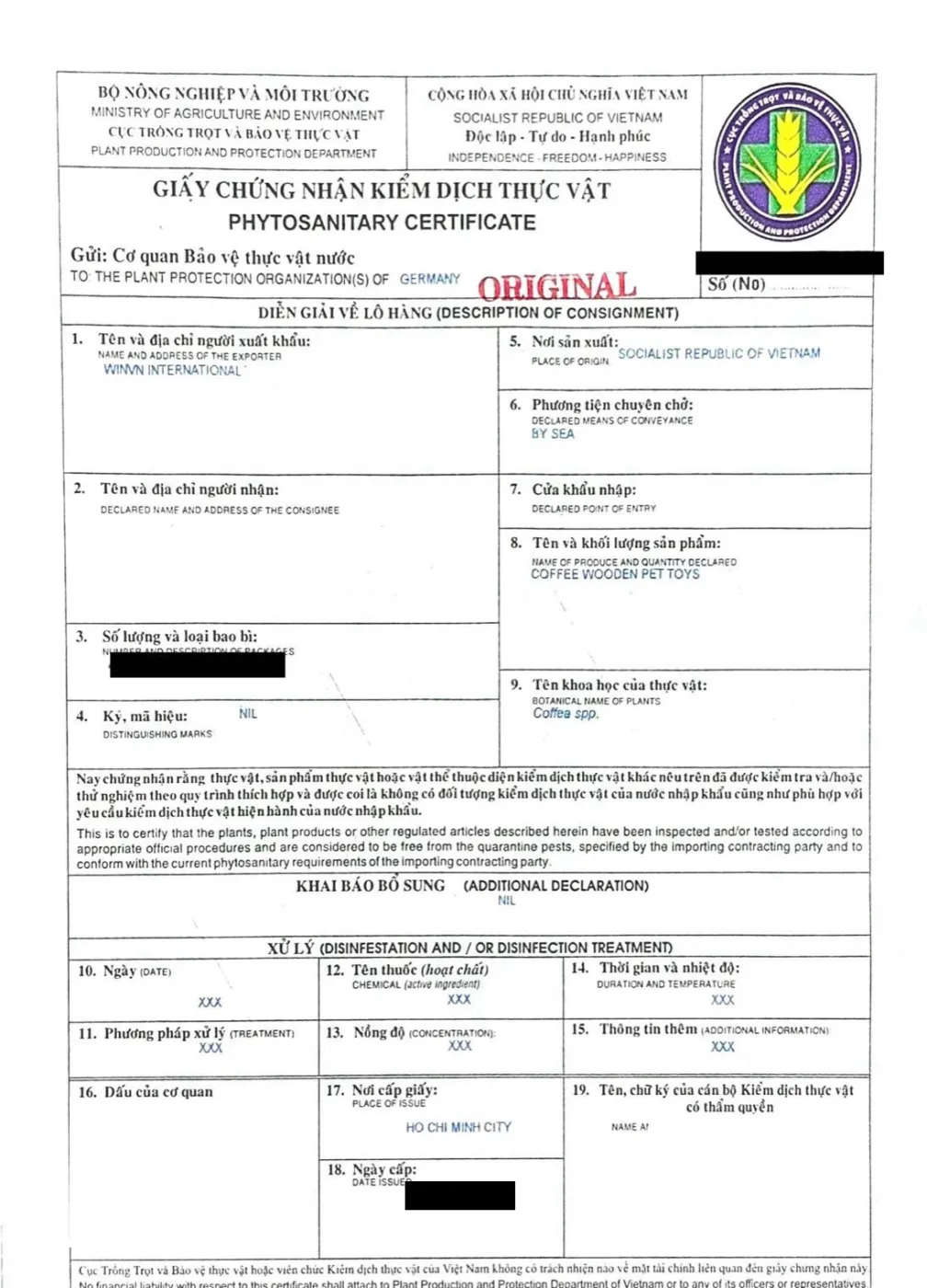
A phytosanitary certificate is issued by a country's plant protection authority to state that a plant product was inspected and meets the importing country's plant-health requirements. In Vietnam it is issued by the Plant Production and Protection Department. Coffee wood, hemp, coco coir and loofah are of plant origin, so we apply for a phyto when the destination requires plant inspection. Whether your goods need one in your member state, your importer or customs broker confirms.
What to check on a phyto: the botanical name of each product, net weight matching the packing list, and the correct point of entry. You can see a masked phyto from a shipment to Germany on our documents page.
Fumigation certificate
A fumigation certificate records that the goods were treated against pests before shipping. The masked example on our documents page is a methyl bromide fumigation for a shipment to Germany.
- When it is done. Fumigation is done before export customs clearance.
- Where it is done. On the pallets before the container is loaded, or in the loaded container at the yard, depending on what you ask for.
- When the certificate comes. After the B/L, because the certificate shows the B/L, container and seal numbers.
- Who arranges it. On CIF and DAP shipments, our forwarder arranges fumigation. On FOB, your forwarder does, and we confirm that with them in writing as soon as there is a booking, so no one assumes the other side has it in hand.
Certificate of origin and EUR.1
A certificate of origin states where goods were made. A preferential certificate lets the importer claim a lower duty under a trade agreement. For the EU, the agreement with Vietnam is the EU–Vietnam Free Trade Agreement (EVFTA), and the certificate we have used for EU shipments is the EUR.1 movement certificate. A masked EUR.1 from a shipment to Germany is on our documents page.
Not every product qualifies
A product can be made in Vietnam and still not meet the origin rules for a preferential certificate. So tell us before we quote if you need a certificate of origin, and we confirm it for each line. We only declare the true origin of the goods.
It comes last
A certificate of origin is approved by the issuing authority after the other documents are final, so it is usually the last document of the set. When it is applied for after the ship sails, it is issued marked "issued retrospectively", which is normal. Whether you receive a paper original or an electronic certificate depends on the market. Plan your customs clearance around it, and do not expect it on the same day as the B/L.
The order the documents arrive in
On a sea shipment, the documents follow the goods in a fixed order:
- Container loading plan
- Commercial invoice and packing list
- Shipping instruction and verified gross mass to the carrier
- Draft B/L
- Export customs declaration
- Ship sails; final B/L
- Fumigation certificate, phytosanitary certificate and surrender B/L
- Certificate of origin, last
Keeping the set consistent
Having every document is not enough; they also have to agree with each other. The rules we work to:
- One consignee block, everywhere. Company name, address, EORI and VAT number identical on the invoice, packing list, B/L, fumigation, phyto and origin certificates. Send us one approved block and we copy it exactly.
- Quantities and weights match across invoice, packing list and B/L.
- No more than two decimals on prices, weights and volumes.
- Volume per line on the packing list, adding up to the figure on the B/L.
- Container number on the final invoice and packing list.
- Same voyage. The vessel and voyage details on the phyto, fumigation and origin certificates match the final B/L.
- Free goods. Tell us whether free samples in the shipment should appear on the invoice or not.
- Mixed cartons. Ask your forwarder how quantities should be shown for the EU's ICS2 security filing before the draft B/L is made.
We check the drafts of fumigation, phyto and origin certificates before the originals are issued, because one wrong letter on an original means starting again.
What we do not hold
We do not hold FSC, BSCI or ISO certification, and we have no REACH test report. Our only lab test is an SGS heavy-metal test on coffee wood; see what our SGS coffee wood test covers. If your retailer requires one of the others, tell us before ordering so we can discuss it honestly. Choosing delivery terms for the same order? See FOB, CIF or DAP for a small mixed order.
Questions EU buyers ask about documents
Which documents come with every shipment?
A commercial invoice, a packing list, and a bill of lading for sea freight or an air waybill for air freight.
Do my goods need a phytosanitary certificate in the EU?
Your importer or customs broker confirms what your country requires for your goods. We apply for a phytosanitary certificate when your market requires it.
Can you issue an EUR.1 for every product?
No. Not every product qualifies under the origin rules. Tell us before we quote if you need a certificate of origin, and we confirm it for each line.
Why does the certificate of origin arrive after the other documents?
It is approved by the issuing authority once the other documents are final, so it usually comes last. If it is applied for after sailing, it is marked issued retrospectively, which is normal.
Who arranges fumigation?
On CIF and DAP shipments our forwarder arranges it. On FOB shipments your forwarder does, and we confirm that in writing once there is a booking.
Send us your broker's document list
Tell us the lines you want and the documents your broker needs. We confirm, line by line, what we can issue before we quote.