How to read a bill of lading from a Vietnamese supplier
The bill of lading is the one document that proves your goods were loaded on a ship, and on many shipments it is also the key to collecting them. It is worth reading every field before you pay the balance. This guide walks through a sea B/L field by field, with what to check on each, and how the B/L ties into payment with us.
- For importers and first-time buyers
- Sea freight, FCL and LCL
- About 7 minutes to read
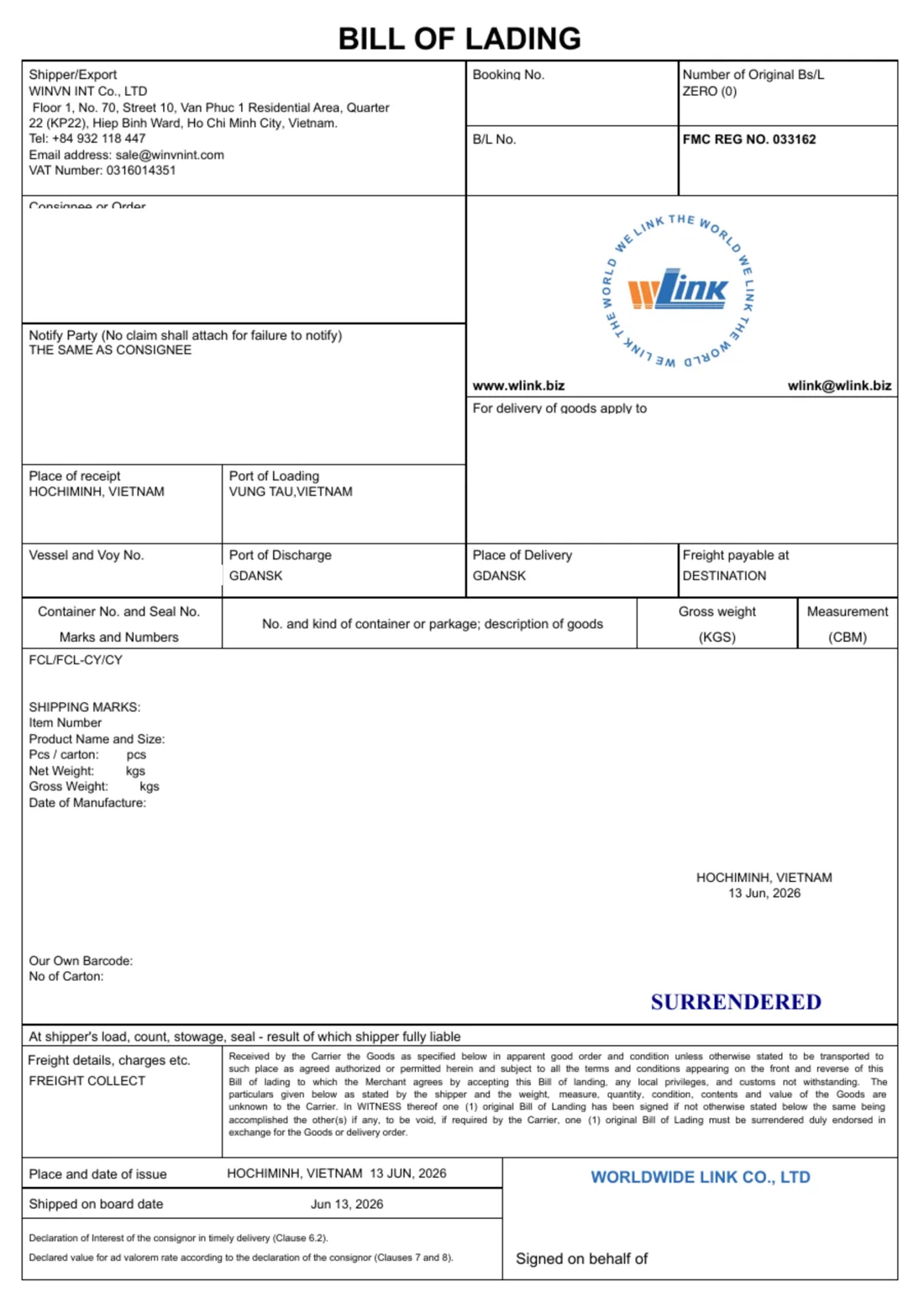
What a bill of lading does
A bill of lading, or B/L, is issued by the carrier or by a forwarder once the goods are on board. It does three jobs at once: it is a receipt for the cargo, it is evidence of the contract of carriage, and in its original form it is the document of title that lets the holder take delivery at destination.
Two kinds are common. A master B/L is issued by the shipping line. A house B/L is issued by a forwarder, typically when cargo is consolidated or when the forwarder books on your behalf. Either way, we do not issue the B/L ourselves.
The parties: shipper, consignee, notify party
Shipper
The exporter who hands the goods to the carrier. Check that the shipper is the company you contracted with and paid. If a different company appears, ask why before you pay anything more.
Consignee
The party entitled to receive the goods at destination, usually you or your customs agent. A misspelt name or a wrong address can stop you collecting the cargo, and changing a B/L after it is issued costs an amendment fee. For shipments to the EU, the consignee block (company name, address, EORI and VAT number) should be identical on the invoice, packing list, B/L and certificates. Send us one approved consignee block and we copy it exactly onto every document.
Notify party
The party the carrier informs when the ship arrives. It can be the consignee, your customs broker, or your warehouse. The notify party and the consignee can be different companies, and that is normal.
The voyage: vessel and ports
- Vessel and voyage number. Use them, with the B/L or container number, to follow the ship on the carrier's own tracking page.
- Port of loading (POL). The port in Vietnam where the goods went on board. It must match the port on the commercial invoice and the export declaration.
- Port of discharge (POD) and place of delivery. Where the goods come off the ship, and where the carrier's responsibility ends if it differs.
- Shipped on board. The notation that the cargo was loaded. The vessel and voyage details on the phyto, fumigation and origin certificates match the final B/L.
The cargo: containers, packages, weights, description
- Container and seal numbers. On a full container (FCL) they identify your box. On a shared container (LCL) the B/L is marked part of a container, often "CFS/CFS", and the container is the consolidator's.
- Number of packages. Cartons or pallets. It must match the packing list exactly.
- Gross weight and measurement. Weight in kilograms and volume in cubic metres, matching the packing list.
- Description of goods. A short trade description. On our export documents a coffee wood chew is described as a wooden pet toy, because it is a toy, not food.
- Mixed cartons to the EU. Ask your forwarder how they want quantities shown for the EU's ICS2 security filing before the draft B/L is made; one practical way is pieces in the quantity field and the carton count in the description.
Freight terms: prepaid or collect
The B/L says who pays the ocean freight. On a CIF sale we book and pay the freight, and the B/L reads freight prepaid. On a FOB sale your forwarder carries the goods and you pay the freight, and the B/L reads freight collect. If the freight term on your B/L does not match the Incoterm on your invoice, ask why before you pay. Which term suits a first order: FOB, CIF or DAP for a small mixed order.
Draft B/L, payment and release
Before the final B/L is issued, the carrier or forwarder produces a draft B/L. This is the moment to catch spelling, addresses, weights and the description, because corrections after issue cost money and time.
With us, payment ties to the B/L. Our terms are T/T, 50% deposit with the order and 50% balance when you receive the draft B/L, on FOB and CIF shipments. Once the balance is received, the B/L is released. Release can take three forms:
- Original B/L. Paper originals sent by courier; you present one to collect the goods.
- Surrender B/L. The originals are surrendered at origin, so the consignee can collect without paper.
- Telex release. The carrier is instructed electronically to release the cargo at destination.
Until the balance is in, the cargo stays on hold. That protects both sides: you pay the balance only once your goods are packed, booked and described on a draft B/L, and the goods are released only to a buyer who has paid.
Why our published B/Ls are masked
Our documents page shows real, masked bills of lading from our shipments. Consignee, notify party, B/L and container numbers are hidden. That is deliberate: with a B/L or container number, anyone can look up a shipment on the carrier's website and find the buyer. We protect every customer's name the same way we would protect yours. See them on the documents page.
The certificates that travel with a B/L are explained in EU export documents for pet toys, and the wider supplier checklist in sourcing natural pet toys from Vietnam instead of China.
A short checklist for any supplier's B/L
- Is the shipper the company you contracted with?
- Is the consignee block spelled exactly as on your invoice?
- Do packages, weight and volume match the packing list?
- Does the port of loading match the invoice?
- Does the freight term match the Incoterm?
- Do the certificates name the same vessel and voyage as the final B/L?
- Can you find the container or B/L on the carrier's own website?
Questions buyers ask about bills of lading
Who issues the bill of lading on your shipments?
The shipping line issues a master B/L, or a forwarder issues a house B/L. We do not issue it ourselves.
When do I pay the balance?
On FOB and CIF shipments, the 50% balance is due when you receive the draft B/L. For air shipments on DAP terms, the balance is due once the goods are ready, before pickup.
When is the B/L released?
Once the balance is received. Release can be by original B/L, surrender B/L or telex release.
Why are the B/Ls on your website masked?
A B/L or container number lets anyone look up the shipment and find the buyer. We hide consignee, notify party, B/L and container numbers to protect every customer.
What does freight collect mean on my B/L?
It means the ocean freight is paid at destination, which is normal on a FOB sale where your forwarder carries the goods. On our CIF sales the B/L reads freight prepaid.
See real, masked B/Ls
Check the documents from our recent shipments, then tell us your destination port.